Free guide
Is your observability costing morebut telling you less?
A free guide to the five things every observability strategy needs, with worksheets so your team can build your own and decide what to keep, what to cut and what to fix first.
- A bill you can explain
- Alerts your team trusts
- Faster answers when things break
Building your strategy will help you solve these common problems
Every quarter costs more, and nobody can say which labels, logs or teams are driving it.
Every few months someone asks whether you have the right tools. Without evidence, the debate never ends.
You're building something big and want observability designed in, not bolted on after the first outage.
Hundreds of dashboards and alerts, yet incidents still start with “has anyone looked at…?”
The licence is signed, but only a few teams have moved over. The rest stick with old dashboards and old habits.
“Monitoring should give you answers, not more data.”
You don't need more tools. You need a plan your team owns.
Most teams already collect more data than they can use. The bill keeps growing, alerts get ignored, and when something breaks nobody is sure where to look. It's hard to step back and fix that while you're busy keeping things running. We've been there. We'll help your team build the strategy and the skills to do it yourselves.
Start with the guide
Work through the five areas and the worksheets at your own pace, and spot the quick wins your team can make first.
Get unstuck when you need to
If a question stalls you, such as which signals matter or what to do about the bill, talk it through with us and keep moving.
Your team owns the result
We help your people build the skills and the confidence to run it themselves, so the strategy lasts after we have gone.
Need more help? Bring us in
If you want an expert view, we can run an observability assessment with your team and give you the tools and where to focus first.
Free guide
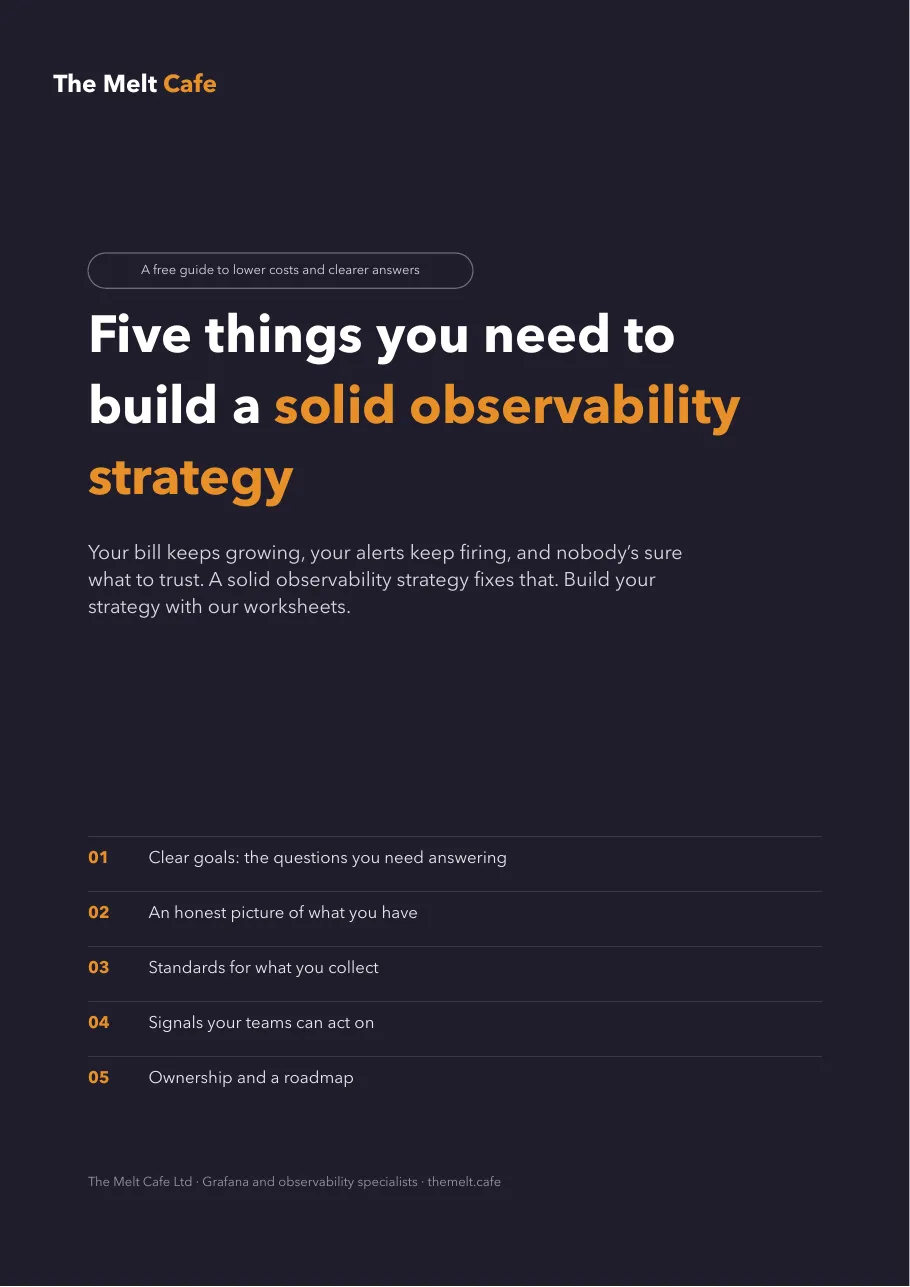
Five things you need to build a solid observability strategy
Nine pages, one for each of the five things, with questions to ask your team and a worksheet for each. It finishes with a one-page strategy overview you can share.
- 01 Clear goals: the questions you need answering
- 02 An honest picture of what you have
- 03 Standards for what you collect
- 04 Signals your teams can act on
- 05 Ownership and a roadmap
Written by the co-authors of Observability with Grafana (Packt).
What's at stake
Without a strategy
- The bill doubles and nobody can explain why
- Alert fatigue means real incidents get missed
- The tool debate drags on
- New platforms launch blind
- Your best engineers firefight the tooling
With one
- Fewer, better alerts your on-call team trusts
- A confident tooling decision
- Observability designed in before go-live
- Dashboards people actually use
- A bill you can explain, team by team
Want us to do it with you?
Book a three-week, fixed-price observability assessment. We work alongside your team and leave you with a plan you can deliver yourselves, or with our support.
Step 1: Book a call
A free 30-minute call to understand your stack and what you need from it.
Step 2: Three-week assessment
We review telemetry, costs, dashboards and alerts, and talk to the people who use them.
Step 3: Get your roadmap
A prioritised plan you can deliver yourselves, or with our support.
What you get
- An agreed strategy on a page
- A telemetry volume and cost baseline
- Instrumentation and collection standards
- Alerting and dashboard standards
- Prioritised improvements
- A 90-day roadmap
Questions
Is the guide really free?
Yes. We'll email it to you straight away, with no sales call attached. We only send tips if you tick the box, and you can unsubscribe any time.
Do we have to use a specific platform?
No. Often the best platform is the one you already have. We'll tell you if we think switching is worth it.
Can our team do this without help?
Yes. The guide and worksheets are built for that. If you get stuck, talk to us.
What does an observability assessment cost?
It's a fixed price, sized to your estate after a free 30-minute call and agreed before we start.